
How to strap a kayak to your SUV roof: A real-world guide
Before the amazing Portland Kayak Company closed down (the owners retired), I rented a Delta sea kayak for a two-day paddle on the Willamette. It was a long, sleek boat, way more kayak than I usually haul around.
If you've ever stood next to your SUV with a 14-foot kayak and a tangle of straps in your hands, you know the feeling. You want it secure. You want it not to scratch your car roof. And you really, really don't want to see it sliding sideways in your rearview mirror on the freeway.
Luckily, we had help from expert kayakers who coached us through it. So how do you strap a single boat with foam supports on factory roof rails on your SUV? Here’s what we learned from the people who haul kayaks all day for a living.
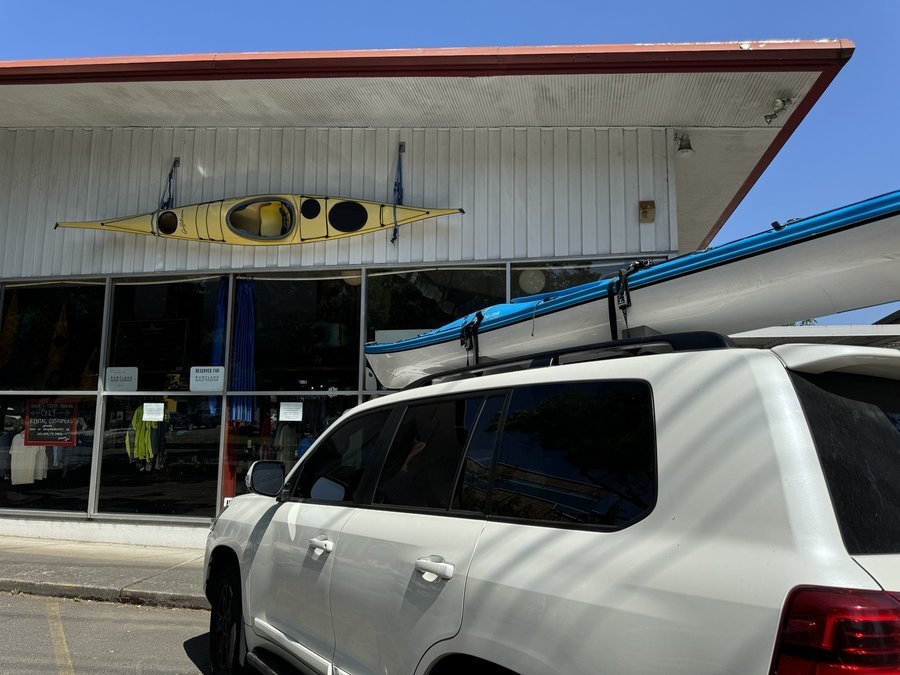
What you need
For a single hardshell kayak on an SUV with factory crossbars or rails, you really only need a few things:
Two foam blocks or saddle pads (the notched kind that sit on your crossbars)
Two cam-buckle straps, 12 to 15 feet long
A bow line and a stern line (rope or a short cam strap)
A clean roof — wipe off grit before you load
Skip the ratchet straps. They feel reassuring because they cinch hard, but that's the problem, the owner told us — they cinch too hard and can deform a composite or thermoformed hull. Cam straps give you firm without crushing.
Step 1: Set the foam blocks
Foam blocks go on the crossbars, one near the front, one near the back, spaced as wide as your roof allows. The notch sits over the bar so they don't slide around when you're loading.
If your SUV has a sloped roof or a sunroof, double-check that the kayak won't actually rest on the glass when it settles in. The blocks should be doing all the work.
Step 2: Load the kayak
Lift the boat onto the roof, hull-down, deck-up, centered side-to-side and roughly centered front-to-back. On a longer kayak like the Delta, a little extra length out the back is fine. A little extra out the front is fine too. What you don't want is the boat sitting lopsided on one side of the vehicle.
A second set of hands makes this easier. If you're solo, rest the bow on the back of the roof first, then walk the stern up.
Step 3: Run the cam straps
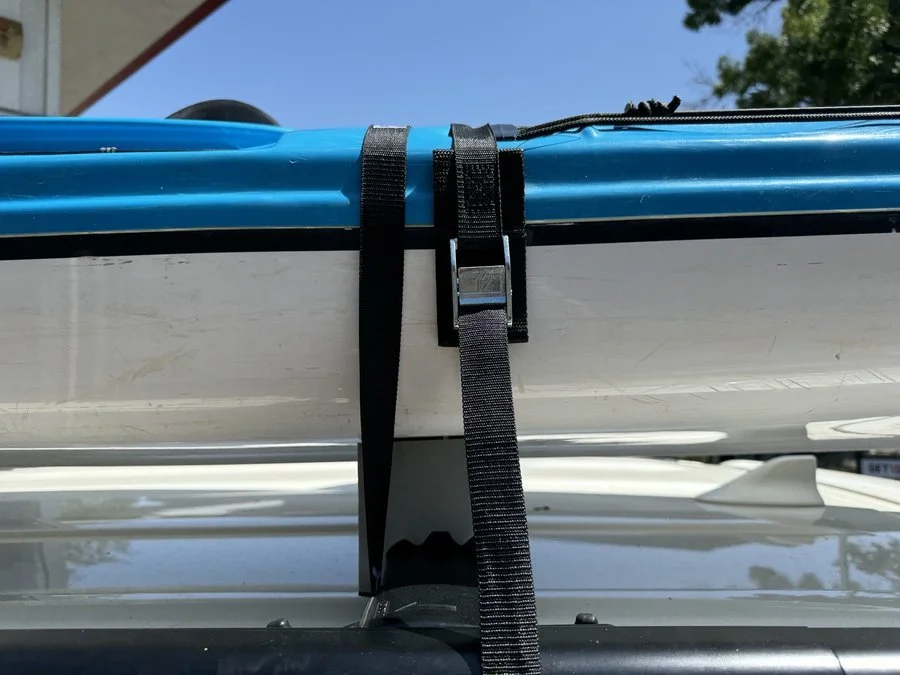
This is where most people get it wrong. The strap goes over the kayak, under the crossbar, back over the kayak, and into the buckle on top.
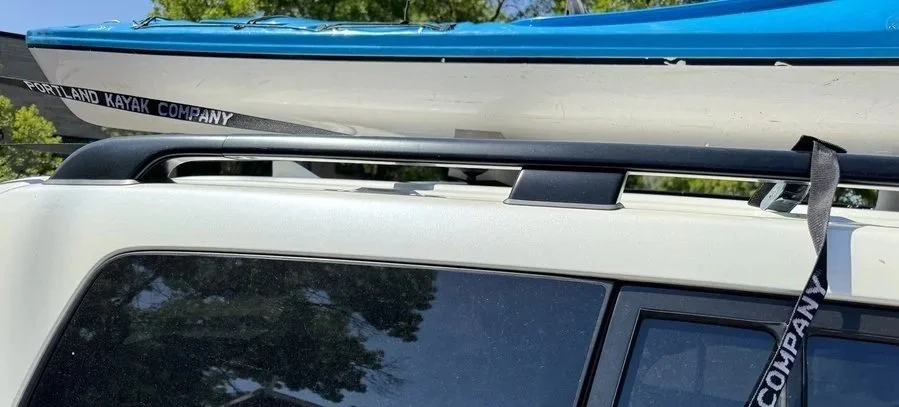
A few things we were taught:
Throw the buckle end gently over the boat — never whip it across, or it'll crack a window
The buckle should sit on the hull, not against the roof rail, so it doesn't rattle paint off your car
Keep the straps parallel to each other, not crossed
One strap at the front crossbar, one at the back. Don't try to do it all with a single strap
Tighten until the kayak doesn't shift when you push down on it firmly. You shouldn't be standing on the strap to tension it. Snug, not strangled.
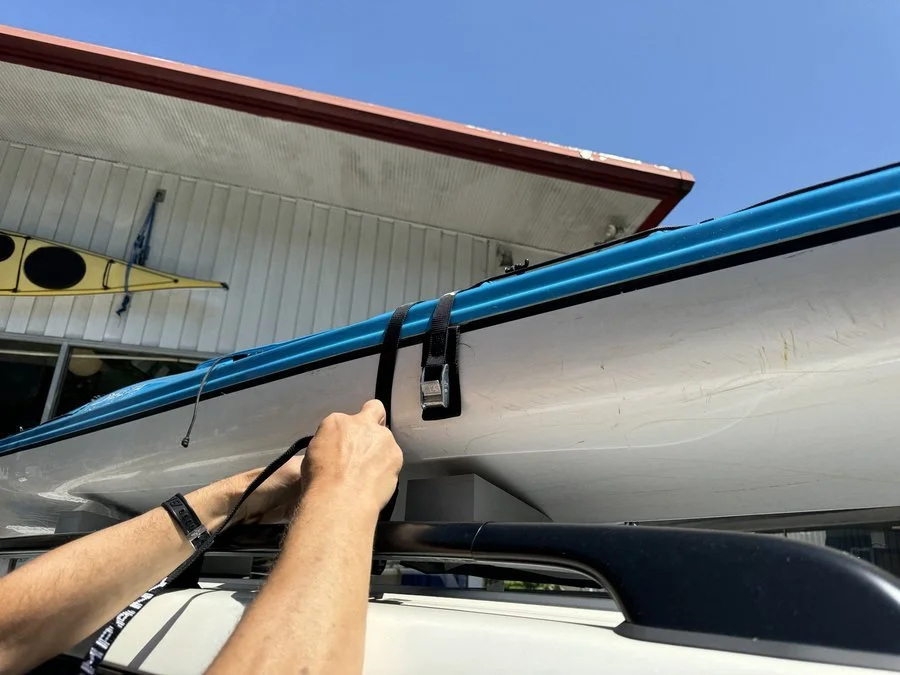
Step 4: Tie off the loose ends
This part gets skipped a lot. Long, flapping strap ends will buzz against your car at highway speed and slowly sand the paint off — or worse, work themselves loose. Twist them up and tie a couple of half hitches around the taut part of the strap. Done.
Step 5: Add bow and stern lines
I know — they look like overkill in the parking lot. But the first time a semi blows past you on I-5 and you feel the whole boat lift, you'll be glad they're there.
Run a line from the bow of the kayak down to a tow hook or anchor point under the front of your SUV. Do the same from the stern to the rear. Just snug — they're there to stop the boat from sliding forward or back, not to torque it down.
If your SUV doesn't have visible tie-down points, hood loops are cheap and bolt under the hood latch.
The shake test
Before you drive off, grab the kayak by the bow and try to wiggle it side to side, then up and down. The whole vehicle should rock with it. If the boat moves and the car doesn't, something's loose. Re-tension and try again.
Then drive a couple of miles, pull over, and check everything again.
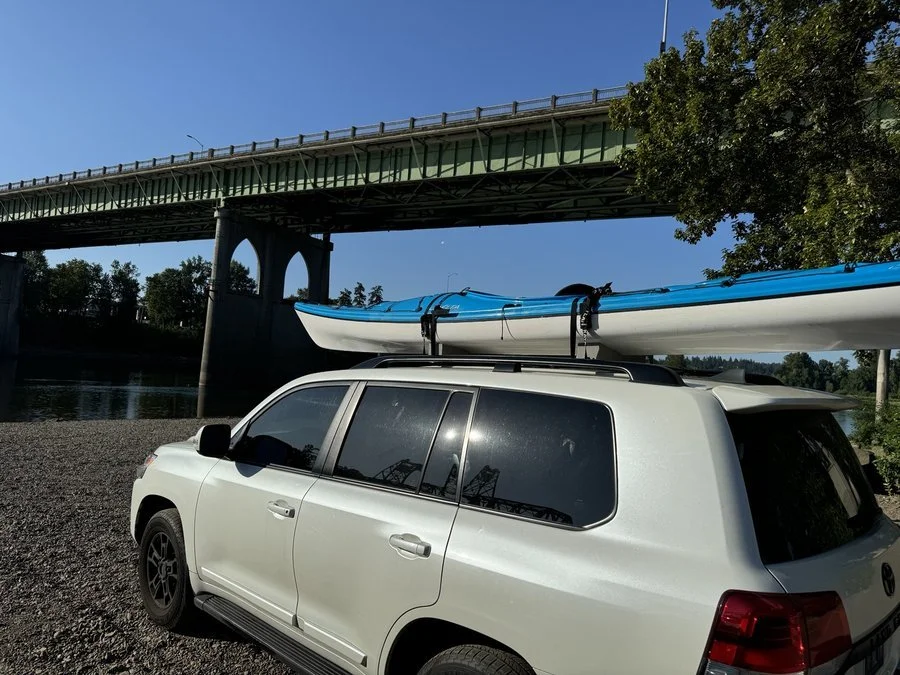
A few real-world tips:
Don't leave the boat strapped down overnight.
Cam straps under tension for days will leave dents in the hull and bake UV damage into the deck.
Watch your speed.
I keep it under 55 MPH with a kayak up top. Wind load on a 14-foot boat is no joke.
Loose foam blocks are a problem
If your blocks slide around on the crossbars, you don't have a stable foundation. Some have rubber on the underside; if yours don't, a strip of grip tape on the bar helps.
This setup is for hardshell kayaks
If you find yourself doing this drive often, it's worth thinking about whether a folding kayak would save you the rooftop logistics altogether. (I went through that math myself after paddle-camping the Willamette with this exact setup — there's a reason most of my trips since have been on an Oru folding kayak).
A quick disclaimer
This is what worked for our SUV with our Delta rental boat. Every vehicle, every rack, and every kayak is a little different. Always check your roof rack's weight rating, your kayak manufacturer's recommendations, and your local laws on overhang flags. If something feels wrong before you pull onto the road, trust that feeling and re-do it. The water will still be there in ten extra minutes, so prioritize safety first.